
 Use An Altar Table:
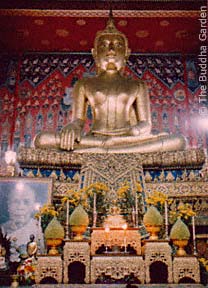
One should never place a statue of the Buddha on the ground inside a home, and in my home country of Thailand, we set our statues upon an altar table. These tables can be quite elaborate; they are often a set of small tables which stack upon one atop another so there are different levels on which to place multiple statues.
But if you don't have an altar table, then something as simple as a small shelf that is cleared specifically for placing the statue will do as well. In rural areas of Southeast Asia, where a family might have almost no furniture, placing the statue on even just a small woven mat is acceptable. The important thing is that the Buddha statues are elevated above the person who is performing pooja - even if it is just the symbolic raising of less than an inch by placing the image on a thin mat barely above the floor.
Create A Pooja Room:
Whenever possible, it is preferable to have a separate room dedicated to performing pooja (Bucha in Thai language) that is kept clean and specifically for the purpose of prayer and making merit (tham boon). Not only does it help to create a "sacred space" in your house clear from items that might be offensive to the enlightened one, but it gives you, the owner of the house, a specific area to meditate, study the Dharma, or contemplate. A separate pooja room is as equally important for the roopa as it is for you. With a separate room, you could include other objects, such as fresh flowers, as well as an area for burning candles and incense, which will be used for making offerings and venerating your Buddha image. In Buddhist monasteries (called a Wat in Thai), there is a building known as the Ubot (Ordination hall, where the main Buddha images is venerated and where ceremonies for monks take place). There may also be Viharna (Wihan) where other statues are kept and the public is invited to listen to Dharma lectures. These Buddhist temples give us a good clue on how to treat our images with respect. Make your room comfortable by having small meditation pillows, and be sure that you remove your shoes when ever you enter your pooja room.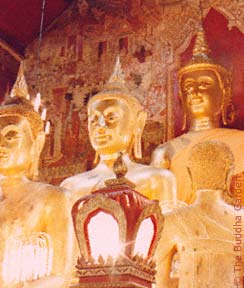 A Place For Veneration:
Understandably, not every house can have a room set aside for placing your statue, in which case you will want to make a special place in a multipurpose room where the statue may be treated with respect.
- Do not put your statue where someone's feet will be pointing toward it. While pointing with your finger at a monk or Buddha image is bad enough, pointing with your feet would be even more offensive.
- Keep the area free of objects that might tower above the image. Do not place your statue near refrigerators or other items that are much larger or much taller.
- Refrain from placing your statue or any other Buddhist related symbol in the bathroom, or any room where acts of passion might take place (I think you know what I mean).
- Position the statue so that it will not hang under laundry lines, as you want to make sure that things such as undergarments and socks will not hover above the statue.
Statue Placement In A Single Room Or Studio Apartment
If you don't have a spare room to devote to veneration, then you can still keep a Buddha statue in a one-bedroom or studio apartment. You can set up a small shelf high on a wall where you can place a small statue. Known as a "Hing Phra" in Thai language, this is commonly done in apartments throughout crowded Asian cities. Often these shelves will feature numerous statues or amulets on them. The general practice among Buddhists is to put the "main"image of the Buddha ("ong prataarn") slightly elevated above the other images, either by placing that main image on a small table or even on a mat, just so long as the main image is elevated (even less than an inch) above the other images.Ultimately, the best location for your statue is the place where the statue will help you the most to conquer anger, overcome greed, and replace ignorance with awareness.
Placing Your Statue In The Garden:
Many people who are not Buddhists will buy statues to decorate their gardens. While we think you should at least try to learn about the Dharma before placing a figure in your garden, by following the above mentioned suggestions you will not be causing offense to Buddhists. Also, if you look at traditional statues you will see that the Buddha is ALMOST never seen touching the ground. Usually, the Enlightened One is depicted standing or sitting upon a lotus. Since you will not be using a wooden altar table in your garden, it would still be advisable to set up a small area where you can elevate the statue, if even just symbolically. One idea is to get several dozen small stones of more or less the same shape. Build up a little mound upon which to place your statue. Occasionally, you may wish to burn three sticks of incense or place three flowers in front of your statue as a sign of respect and veneration.
